


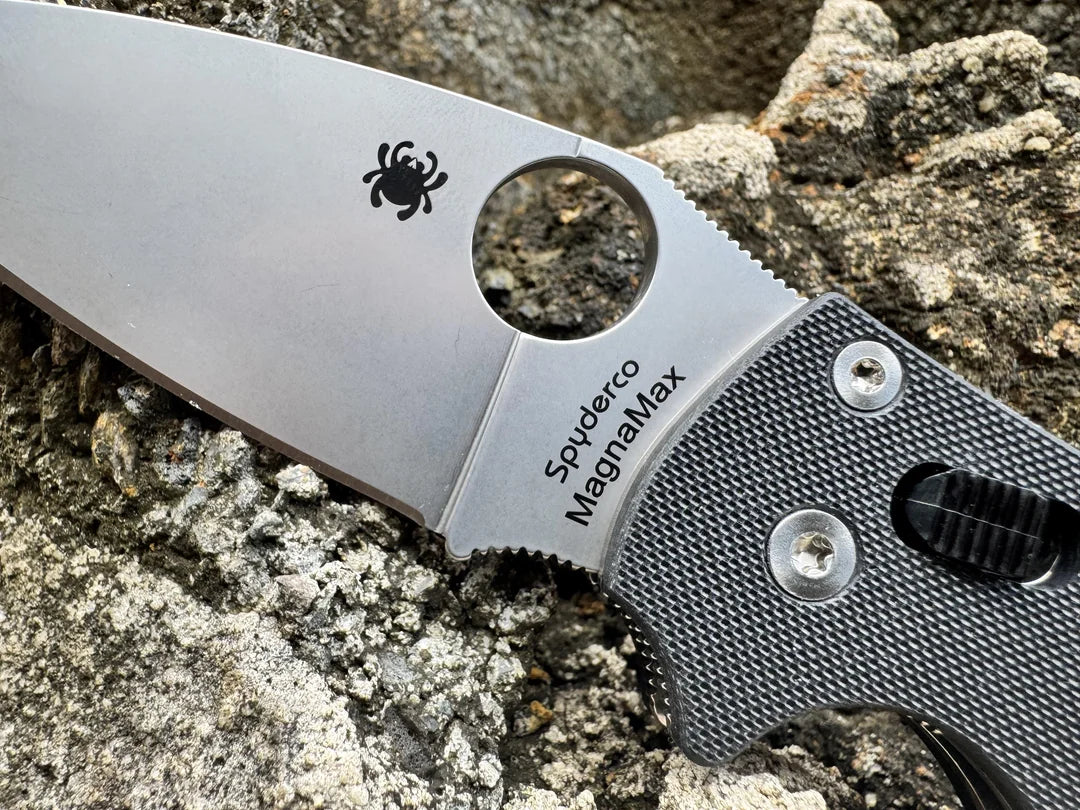
One Metallurgist, Two Elite Steels
When CPM MagnaCut hit the market in 2021, it redefined what knife steel could do. MagnaMax arrived in 2026, pushing the envelope further — but it is not for everyone, and it was never meant to be.
Both steels were designed by metallurgist Dr. Larrin Thomas in collaboration with Niagara Specialty Metals. MagnaCut was originally produced by Crucible Industries, which went bankrupt in early 2025. Erasteel acquired the relevant assets in February 2025, and production continued without interruption. 2026 lab testing confirms that the Erasteel-produced MagnaCut is measurably tougher than the original Crucible formula.
MagnaMax and MagnaCut are sibling steels, not competitors. Each is optimized for a distinct job. This guide will help you figure out which one belongs in your hand.
Why Premium Knife Steel Matters for EDC, Ranching, Bushcraft, and Survival
Choosing a knife steel is not a spec-sheet exercise. The alloy in your blade directly determines how it performs when you are batoning firewood in the rain, field dressing an elk, slicing through baling twine on the farm, or opening boxes at your desk for the hundredth time.
Stainless steel dominated the blade material segment in 2025, capturing 52.6% of the global knife market. Consumers across every category want corrosion-resistant blades that hold up to real conditions. The premium knife segment (blades priced above $200) held a 42% market share in 2025 and continues to grow. A quality knife is a long-term investment, and the steel is its foundation.
EDC users need a blade that stays sharp through frequent slicing tasks with long intervals between sharpenings. Edge retention is the priority. Outdoor fixed-blade users — bushcrafters, hunters, campers, and farmers — put stress on toughness and corrosion resistance. Batoning, chopping, fire prep, camp cooking, and field dressing all punish a brittle blade. Wood carvers occupy a unique middle ground: they need sustained edge sharpness for fine, controlled cuts but enough toughness to handle grain variations without chipping.
No single steel is universally best. The right steel depends entirely on the task. That is exactly why MagnaMax and MagnaCut exist as distinct options.
What Is MagnaCut? The Toughness Standard for Outdoor Fixed Blades
CPM MagnaCut is a powder-metallurgy stainless steel engineered to eliminate the traditional trade-off between toughness and corrosion resistance. For decades, getting one meant sacrificing the other. MagnaCut changed that equation.
The key innovation is in how chromium behaves. In MagnaCut, all 10.7% of the chromium fully dissolves into the steel matrix rather than forming brittle chromium carbides. Every bit of chromium stays active for corrosion resistance. In testing by Knife Steel Nerds, MagnaCut showed no visible corrosion after 72 hours in a 1% saltwater solution — remarkable performance for a steel this tough.
MagnaCut's carbide volume sits at approximately 8%, deliberately kept lower than MagnaMax to preserve toughness. The results are clear: MagnaCut is approximately twice as tough as M390 and approximately twice as tough as CPM S45VN. For hard-use fixed blades, it is typically heat treated to 60 to 61 HRC, a range optimized for batoning, chopping, and absorbing impact without chipping.
That lower carbide volume also makes MagnaCut significantly easier to sharpen in the field than MagnaMax. If you are a bushcrafter or survivalist working with a ceramic rod or a pocket stone, this matters. You can restore a working edge without specialized equipment.
Best use cases for MagnaCut: hunting knives, bushcraft fixed blades, camp knives, field dressing tools, farming and agricultural cutting tasks, and survival knives where toughness and corrosion resistance must coexist.
Industry confidence in MagnaCut is strong. Major brands including Spyderco, Benchmade, Kershaw, Pro-Tech, and Leatherman (which launched its inaugural knife lineup using MagnaCut in July 2025) have all adopted the steel for flagship models.
What Is MagnaMax? Maximum Edge Retention in a Stainless Package
MagnaMax is a powder-metallurgy stainless steel purpose-built for one thing: maximum slicing edge retention. It is not a replacement for MagnaCut. It is a specialization.
MagnaMax uses the same foundational compositional philosophy as MagnaCut but increases carbon, niobium, and vanadium content to dramatically raise wear resistance. The result is a carbide volume of approximately 16%, roughly double MagnaCut's 8%. That carbide volume is the primary driver of its superior edge retention.
To put numbers on it: CATRA testing (Cutlery and Allied Trades Research Association) measures how many cuts a blade makes through a standardized abrasive medium before losing sharpness. A higher score means longer-lasting edge performance. MagnaCut scores approximately 500 on this test. MagnaMax reaches roughly 700 to 750, representing approximately 40% greater edge retention. That is a significant real-world difference.
For steel enthusiasts, here is the exciting part: MagnaMax matches the edge retention of K390 and Vanadis 8 — both well-regarded high-wear non-stainless steels — while maintaining excellent stainless corrosion resistance. This is essentially the stainless K390 that high-wear steel fans have been waiting for.
MagnaMax heat treats to 63 to 65 HRC, a step up from MagnaCut's 60 to 62 HRC range, contributing to its higher hardness and wear resistance profile. Toughness is comparable to 154CM, S35VN, and Carpenter XHP — respectable for a high-wear steel, and better than S110V and M390 in toughness, though it does not match MagnaCut.
There is a practical trade-off to know: MagnaMax's high carbide content demands diamond or CBN (cubic boron nitride) abrasives for sharpening. Standard whetstones will struggle. If you are buying a MagnaMax blade, plan on carrying the right sharpening tools. Field touch-ups require more than a basic pocket stone.
Best use cases for MagnaMax: EDC folding knives, slicing-focused tasks, wood carving where sustained edge sharpness between sessions is the priority, and any application where you want the longest possible intervals between sharpenings.
Alloy Breakdown: Key Compositional Differences
Understanding why these steels perform differently starts with their composition. Here is MagnaCut's nominal makeup:
- Carbon: 1.15%
- Chromium: 10.7%
- Vanadium: 4.0%
- Molybdenum: 2.0%
- Niobium: 2.0%
- Nitrogen: 0.2%
- Iron: Balance
MagnaMax builds on this foundation by raising carbon, vanadium, and niobium content. Those increases push carbide volume from approximately 8% to approximately 16%. More carbide-forming elements mean more hard particles in the steel matrix, which is what gives MagnaMax its edge retention advantage.
Critically, both steels avoid large, brittle chromium carbides. In both MagnaCut and MagnaMax, chromium dissolves fully into the matrix. Corrosion resistance comes from chromium in solution, not from carbides. This is a fundamental design choice that separates both steels from older stainless alloys.
Niobium deserves special attention. It produces very small, extremely hard carbides that contribute to a fine-grained, refined edge. This is a key reason MagnaMax achieves such high wear resistance without becoming excessively coarse in its microstructure. The edge stays refined even at high carbide volumes.
To place both steels in the broader landscape: MagnaCut sits above S35VN and M390 in toughness. MagnaMax sits above S110V and M390 in wear resistance while maintaining better toughness than those high-wear steels.
The trade-off is straightforward: more carbide volume equals more wear resistance and higher hardness, but less toughness and harder sharpening. MagnaMax and MagnaCut each represent a deliberate, optimized point on that spectrum.
MagnaMax vs MagnaCut: Which Steel Is Right for You?
Think of these as two tools from the same family, each built for a different job. Choosing between them is not about declaring a winner. It is about matching steel to task.
Choose MagnaCut if you are:
- A hunter, bushcrafter, survivalist, farmer, or camper who needs a hard-use fixed blade
- Working in wet conditions where corrosion resistance is non-negotiable
- Relying on basic field sharpening tools like a ceramic rod or pocket stone
- Batoning, chopping, or doing any task that puts lateral stress on the blade
For hard-use fixed blades, look for MagnaCut heat treated to 60 to 61 HRC.
Choose MagnaMax if you are:
- An EDC folder user who wants maximum time between sharpenings
- A wood carver who prioritizes sustained sharpness between sessions
- Focused on slicing performance and willing to invest in diamond or CBN sharpening tools
- Looking for the cutting longevity of K390 or Vanadis 8 with stainless corrosion resistance
For EDC folders in MagnaMax, 63 to 65 HRC is the target range. The sharpening gap is a practical reality worth repeating: if you are in the field without diamond or CBN abrasives, MagnaCut is the more forgiving choice. For survivalists and bushcrafters, that accessibility can make all the difference.
Both steels represent the current pinnacle of stainless powder-metallurgy engineering. Our expert staff at North River Outdoors can help you match the right steel to your specific use case, whether you visit us in our Virginia store or reach out online.
The Bottom Line
MagnaCut is the toughness-first stainless steel for hard-use outdoor and field tasks. MagnaMax is the edge-retention-first stainless steel for EDC and precision cutting. Both come from the same designer, and both are exceptional at what they were built to do.
The Erasteel transition has kept MagnaCut supply stable and quality high. The 2026 Erasteel-produced formula tests tougher than the original, so buyers can invest in MagnaCut blades with full confidence. MagnaMax is a new development this year, and availability in production knives will grow as more manufacturers adopt it.
If you are ready to explore knives in either steel, visit our NORTH RIVER OUTDOORS Store or browse Online. Our staff has been helping customers match the right blade to the right job since 2012. For anyone investing in a high-carbide steel like MagnaMax, our professional knife sharpening services are here to keep that edge performing at its best for years to come.
Share:
You Just Paid $200 for a Benchmade — So Why Isn't It Wicked Sharp?